
4. Understanding the Genealogy Research Process
- Sarah Kelly
- Jan 28
- 5 min read

Updated: Jan 31
Genealogy can feel like a thrilling treasure hunt, especially when you stumble across a new ancestor or uncover an unexpected family connection. But even the seasoned researcher can fall into the bad habit of chasing rabbit holes every once in a while. You’ll start with one ancestor and end up at the public tree of a 3rd cousin 5x removed for a completely different ancestor, completely unsure how you got there.
To be fair, great discoveries can happen that way. However, professional genealogists must rely on thoughtful, methodical processes to stay organized, evaluate evidence properly, and reach sound conclusions. Whether you’re a curious beginner or a hobbyist ready to level up your skills, understanding the genealogy research process can help you avoid frustration, save time, and build a more accurate family tree.
Many genealogists have given their own two-cents as to what this process looks like. After reviewing the research processes of many professionals, I’ve compiled my own two-cents. Frankly, we’re all saying roughly the same thing.
1. Start with a Clear Research Question or Objective
Some genealogists will tell you to start a research plan by reviewing what you already know. While that’s how every tree starts, it shouldn’t be how every project starts. Eventually, you’ll know too much to review!
Instead, start with what you want to know. Every strong genealogy project begins with a clearly defined research question. Rather than starting with “I want to learn everything about my family,” professionals focus on specific, answerable objectives, such as:
“Who were the parents of Mary Davis, born in Kentucky around 1870?”
“What happened to John Kelly after the 1920 census?”
“Can I determine whether Anna was adopted or biologically related to her parents?”
A focused research question sets boundaries for your work and gives you a way to evaluate whether a new record actually helps, or simply distracts.
📝 Pro Tip: Professionals write a new research objective for every project, even when working on the same family. If you’re feeling stuck, try turning a vague curiosity into a concrete question.
2. Review & Analyze What You Already Know
Now we can look at what we already know! Gather all the information you’ve already collected, and take the time to evaluate what you already have. This could include family stories, documents, prior research, online trees, and even assumptions you’ve made along the way. Now you can analyze it all through the lens of what question you’re trying to answer.
Ask yourself:
What facts are supported by sources? What facts are not supported by sources?
Are there gaps in the timeline?
Are sources missing or questionable?
Are there conflict dates, locations, or relationships?
This step establishes a baseline for your research and prevents unnecessary duplication. It’s also a good time to revisit records with fresh eyes. You’d be surprised how often we miss a key detail and can answer our research objective just by looking through the information we already have!
3. Consider Locality and Available Records
Good genealogy research is rooted in places. Before searching randomly, professionals consider where an event likely occurred and what records existed in that location at that time.
This may include:
Understanding boundary changes (county, state, or parish)
Identifying whether civil registration was in place
Determining which religious, court, land, or archival records might apply
Knowing what records should exist—and where they are housed—helps shape a realistic and efficient research plan.
I’ll be honest, depending on my research objective, I may not go into as much depth as I should during this step of the process. The Research Like A Pro team at Family Locket, however, provides great resources on how to create a Locality Guide for your research project. I personally refer frequently to FamilySearch Research Wiki, which has already compiled a plethora of resources for localities across the world. It may not house every resource, but it is a good place to start.
4. Create a Research Plan
With a clear objective, known information, and locality context in mind, genealogists develop a research plan. This plan outlines:
The research objective
A summary of known facts
Working hypotheses to test
Specific records or repositories to search
A prioritized research strategy
The plan provides structure without too much rigidity. Records may lead you in unexpected directions, but a plan helps you stay intentional rather than overwhelmed. When you notice yourself starting to jump down rabbit holes, the research plan helps you get back on track.
Where do you put this research plan? It’s up to you. I personally like making a working Google Drive folder that holds all documents and sources related to a research objective. I also have templates on Notion.so I utilize to keep everything organized. Future blog posts will dedicate plenty of time to organizing your genealogy research!
5. Search, Record, and Cite
Now comes the actual searching! But remember: discovery without documentation just looks like a guess.
Each time you find a record (birth certificate, census entry, obituary, etc.):
Record the details of the record (even when results are negative)
Save copies of the documents (digitally or on paper)
Cite every source—where it came from and how you found it
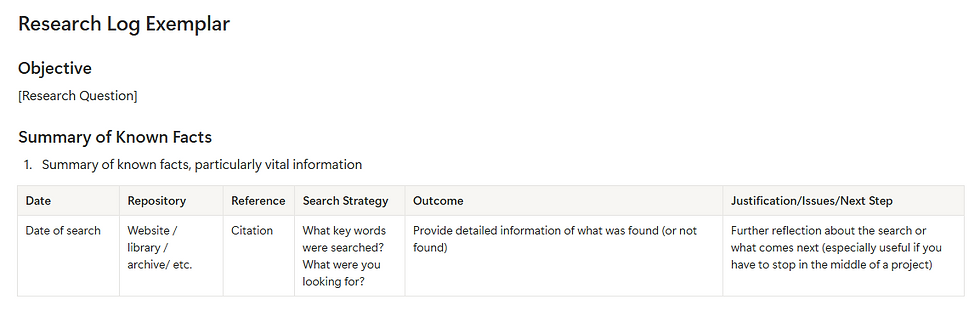
Research logs and source citations are essential tools for professionals. They allow you to track progress, avoid repeating searches, and explain how you reached your conclusions.
There are a plethora of online examples of research logs available for genealogists. Nevertheless, it’s not necessarily about which research log you use, but that you use one at all. The following is an image of my own template that I created with Notion.so. Future blog posts will deep-dive into this process.
📝 Pro Tip #1: Even if you’re not writing formal citations, include the basic who/what/where/when of every source.
📝 Pro Tip #2: Negative results are still results, and they should be documented in your research log!
6. Evaluate the Evidence
Not all records are created equal, and finding the record is only half the job. Each source must be evaluated for its quality, and each piece of information evaluated for its reliability and relevance to the research question.
Consider:
Is this source original or a transcription (or other derivative source)?
Was the information recorded close to the event (e.g., birth date vs. a delayed certificate)?
Who was the informant? What was their level of knowledge of the event?
Does the evidence directly answer the question, or does it require interpretation?
Sometimes, you’ll find conflicting information. That’s normal. What matters is how you weigh the evidence and decide what’s most reliable.
7. Write Conclusions & Research Reports
Writing may seem like an “extra” step, but it’s where a genealogist reaches a defensible conclusion. A report helps you:
Explain your reasoning
Summarize evidence and sources
Document conclusions clearly
Identify remaining questions or next steps
Professional genealogists write reports for every project, not only for clients. Even a brief written summary preserves your work and allows others (or just future you) to understand what was done and why. This may help you and others avoid repeating research, and it better saves your work for posterity’s sake.
8. Repeat the Process (as needed)
Genealogy is iterative. Each conclusion often leads to new questions, and the process begins again with a refined objective and a stronger foundation.
Good research isn’t about finding quick answers. It’s about building accurate, well-supported conclusions that stand the test of time.
Good Genealogy Is Intentional
Anyone can build a family tree, but thoughtful, evidence-based research takes intention. The professional research process doesn’t make genealogy harder—it makes it better.
Feeling overwhelmed or unsure where to begin? That’s exactly where professional guidance can help. I offer consultations, project support, and full-service research for individuals and families at every stage of their journey.
Drop your questions in the comments or contact me to talk about how I can help you dig deeper into your family’s story.
And stay tuned for the next post in our Intro to Genealogy series: 5. What’s the Difference Between Genealogy and Family History?


Comments